



Quality & Me
Subir shares his own personal efforts to work toward continuous improvement within his own community, among his friends and family.
Books by Subir





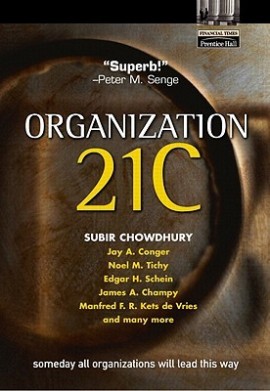





 While reading a book titled The Leader of the Future and co-authored by Frances Hesselbein and others, Subir Chowdhury was keenly interested in Ms Hesselbein’ s leadership style and ideas on how leadership and organizational development would be impacted in the new millennium. This was back in 1997 and thus began a long relationship between Hesselbein and Chowdhury. Eventually, through intellectual exchanges with Hesselbein, Chowdhury was inspired to write Management 21C, a book that drew on thoughts of 26 of the world’s top thought leaders on management, including Hesselbein.
To honor his mentor and friend, in 2012 Chowdhury and The Subir and Malini Chowdhury Foundation provided a lifetime endowment for The Frances Hesselbein Medal for Excellence in Leadership and Service. The award is bestowed annually to a cadet who best exhibits excellence in mentorship and leadership by example at the United States Military Academy at West Point.
In May of 2012, The Department of Behavioral Sciences and Leadership (BS&L) at the United States Military Academy at West Point awarded its first Frances Hesselbein Medal for Excellence this past May to Cadet Chris Jarrett ’12. Going forward, BS&L will hand out this award annually to the cadet who best exhibits superiority in mentorship and leadership-by-example at the United States Military Academy at West Point as determined by peers and faculty.
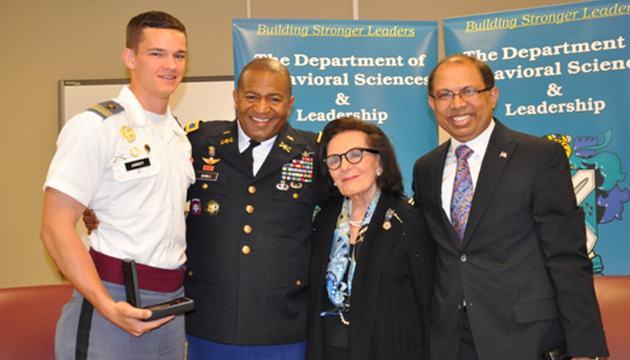
From L-R – Cadet Chris Jarrett ’12 – Inaugural Winner of the Frances Hesselbein Medal for Excellence in Leadership and Service, COL Bernie Banks (Head of the Department of Behavioral Sciences & Leadership), Frances Hesselbein, and Subir Chowdhury.